

How faulty section identification works in distribution networks
Every power outage has a clock running from the moment it starts. The longer crews spend searching for the fault location on an overhead line, the longer customers stay in the dark — and the higher the cost to the utility. Faulty section identification is the process that cuts that search time down from hours to minutes, and modern fault indicator technology is what makes it possible at scale.
Why "Finding the Fault" is harder than it sounds
A medium-voltage distribution feeder can stretch for tens of kilometers, branching into multiple laterals along the way. When a short-circuit or earth fault occurs somewhere on that network, the circuit breaker or recloser at the substation trips — but it gives operators almost no information about where the fault is. All they know is that something is wrong somewhere downstream.
Traditionally, repair crews would drive the entire feeder route, visually inspecting poles and conductors until they found the problem. On a long rural feeder with multiple branches, that could easily take two to four hours. During that time, all customers on the affected segment — and often on healthy segments that were unnecessarily de-energized — remained without power.
Faulty section identification changes the logic entirely. Instead of searching for the fault after it happens, the system already knows which section contains it.
The role of fault indicators
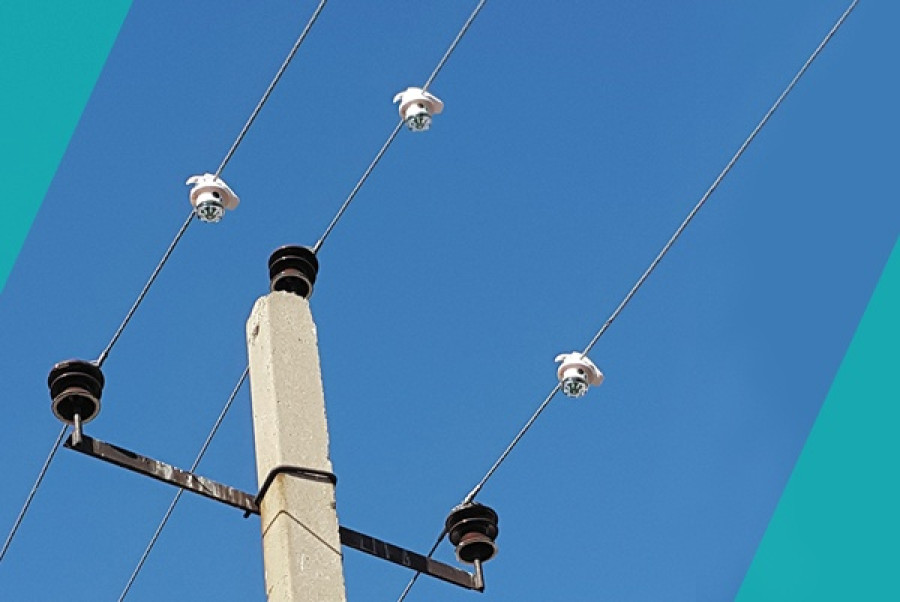
Fault indicators (also called fault passage indicators, or FPIs) are devices mounted directly on overhead line conductors or at pole locations throughout the feeder. Their job is to detect the passage of fault current — whether from a short circuit between phases, or from a single-phase earth fault — and to signal that the fault passed through their location.
When a fault occurs, every fault indicator between the substation and the fault point "sees" the fault current and triggers its flag. The indicators beyond the fault point do not — because no fault current flowed past them. This pattern of tripped and non-tripped indicators immediately narrows the fault location to a specific line section: the segment between the last indicator that tripped and the first one that did not.
That is the core principle of faulty section identification based on fault indicators, and it is both elegant and practical.
From simple flags to smart network data
Early fault indicators relied on a physical flag — a visible mechanical indicator that crews could spot while driving the line. That alone was a significant improvement, but it still required a visual patrol of the entire feeder to check the status of each flag.
Modern fault indicator systems go much further. Each indicator communicates its status — tripped or not tripped — to a central control system via a wireless communication unit. The control center receives this data within seconds of the fault, and the fault management software automatically identifies the faulty section based on the pattern of received fault flags.
The analysis also takes into account:
- The topology of the distribution network — which sections connect to which, and how feeders branch into laterals
- Pre-fault and post-fault current measurements from the indicators, which help distinguish between a genuine fault and a transient event
- Circuit breaker and recloser statuses, which confirm which parts of the network were isolated and when
- Feeder and lateral loading data, which helps validate fault scenarios in networks with distributed generation
Together, these inputs allow the system to pinpoint the faulty section with high confidence, even in complex radial or meshed network configurations.
Short-circuit faults vs. earth faults: different problems, same solution
Not all faults are the same, and faulty section identification must handle both major fault types.
Short-circuit faults occur when two or three phases come into contact — through a fallen conductor, a damaged insulator, or contact with a tree. These faults produce very high currents that are relatively easy to detect.
Earth faults (single-phase-to-ground faults) are more common in medium-voltage networks but significantly harder to detect. In networks with an isolated or compensated neutral (Petersen coil), the earth fault current can be very small — sometimes just a few amperes. The fault may persist for hours without triggering a line trip, all while creating a dangerous touch voltage risk at the fault point.
Modern short-circuit and earth fault indicators are designed to detect both fault types. For earth faults, they use specific detection methods — transient analysis, directional measurement of zero-sequence current — to reliably identify which section contains the fault even when the fault current is low. This is critical, because without proper earth fault section identification, network operators either ignore the fault (which is dangerous) or de-energize large sections of the network to find it (which is costly).
Integrating faulty section identification into grid operations
Faulty section identification does not work in isolation — its real value comes from how it integrates into the wider grid control environment.
When the fault location data reaches the SCADA or fault management software, operators can immediately dispatch repair crews to the right place. But with automation, the system can go further: it can automatically open the sectionalizing switches that isolate only the faulty section, then restore power to all healthy segments. This is the logic behind FLISR — Fault Location, Isolation, and Service Restoration — which reduces outage duration for unaffected customers from minutes to seconds.
For utilities working toward Smart Grid compliance or improving their SAIDI/SAIFI reliability metrics, this kind of automated fault section identification is not a luxury — it is a fundamental building block.
What good faulty section identification looks like in practice
A well-implemented fault identification system has a few defining characteristics:
Speed. The control center should have fault flag data within seconds of the fault occurring, not after a crew patrol that takes hours.
Accuracy. The system should correctly identify the faulty section even in the presence of missed or incorrect indicator readings — which can happen due to communication errors or abnormal fault conditions. Redundant logic and current measurement data help here.
Coverage. Indicators need to be deployed at appropriate intervals along the feeder, including on laterals. A gap in coverage is a gap in identification capability.
Reliability in harsh conditions. Overhead line equipment operates in rain, ice, extreme heat, and high wind. Fault indicators must maintain their detection and communication functions throughout.
Integration. The fault flag data should flow directly into the utility's existing SCADA or DMS (Distribution Management System), not sit in a separate silo.
When these elements come together, faulty section identification becomes a routine, automatic part of grid operations — something the control center knows within a minute of any fault, without anyone driving a single kilometer of feeder.
The bottom line
Faulty section identification is one of the most impactful improvements a distribution utility can make to its operations. It directly reduces outage duration, cuts crew patrol costs, improves safety by quickly pinpointing dangerous fault locations, and provides the data foundation for network automation.
The technology to do this — overhead line fault indicators with communication capability, combined with software that maps fault flag patterns to the network topology — is mature, proven, and deployable on existing overhead lines without major infrastructure changes.
For utilities still relying on manual patrols to find fault locations, the question is not whether to implement faulty section identification, but how soon.
Frequently Asked Questions
What is faulty section identification in a power distribution network?
Is the process of automatically determining which specific segment of an overhead or cable distribution line contains a fault — such as a short circuit or earth fault — immediately after it occurs. Rather than sending crews to patrol the entire feeder, the system uses fault indicators installed along the line to pinpoint the affected section within seconds.
How do fault passage indicators help locate a fault on an overhead line?
When a fault occurs, every indicator between the substation and the fault point detects the fault current and triggers its flag — while indicators beyond the fault point show no response. That boundary marks the faulty section. In modern systems, this information is transmitted wirelessly to the control center in real time, so operators know the fault location without any physical patrol of the line.
Can fault indicators detect earth faults, not just short circuits?
Yes. Modern fault indicators are designed to detect both short-circuit faults and earth faults, including high-resistance earth faults in networks with an isolated or compensated neutral. Earth fault detection typically relies on transient analysis or directional measurement of zero-sequence current, since earth fault currents can be very low — sometimes just a few amperes — and standard overcurrent detection alone is not sufficient.
What is the difference between fault location and faulty section identification?
Fault location typically refers to calculating the precise distance to the fault point — often in meters or kilometers from the substation — using impedance-based or travelling-wave methods. Faulty section identification is a broader, more practical concept: it narrows the fault down to a specific line section between two known points, such as two consecutive fault indicators or switching devices. For most field operations, knowing the faulty section is sufficient to dispatch crews directly to the fault area.
How does FLISR relate to faulty section identification?
FLISR — Fault Location, Isolation, and Service Restoration — is an automation workflow that builds directly on faulty section identification. Once the system identifies the faulty section, FLISR automatically sends switching commands to isolate only that segment, then reconfigures the network to restore power to all healthy sections. The result is that customers outside the faulty section experience a brief interruption lasting only seconds rather than a prolonged outage.